
Day 19
Mobility, Stretching, and Corrective Movement
A healthy body is not only a lighter body. It is also a body that moves better, feels less stiff, and supports your daily life with more comfort. If you sit for long hours, work at a desk, look down at your phone, drive often, or avoid movement because of pain or tiredness, your body may start to feel tight, stiff, or limited. Mobility, stretching, and gentle corrective movement can help you reconnect with your body. Today is not about forcing painful positions or becoming extremely flexible. It is about giving your joints and muscles a few minutes of care every day.
Flexibility vs. Mobility
Flexibility and mobility are related, but they are not exactly the same. Flexibility means how much a muscle can stretch. Mobility means how well a joint can move with control. For example, you may be able to stretch your hamstrings, but still struggle to squat well because your hips, ankles, knees, and core do not move together smoothly. Flexibility is about range. Mobility is about usable movement. Both can be helpful, but for daily life and exercise, mobility is especially important because it helps you move with better control.
Sitting Too Much Can Make the Body Stiff
Long sitting can make certain areas feel tight or weak. Your hips may feel stiff. Your lower back may feel tired. Your shoulders may round forward. Your neck may feel tense. Your knees may feel uncomfortable when you stand or climb stairs. This does not mean your body is broken. It often means your body has adapted to the positions you spend the most time in. If you sit for many hours, your body becomes good at sitting. But it may feel less comfortable when walking, squatting, lifting, stretching, or standing for long periods. The solution is not panic. The solution is adding small movement breaks and gentle daily mobility.
Neck and Shoulders
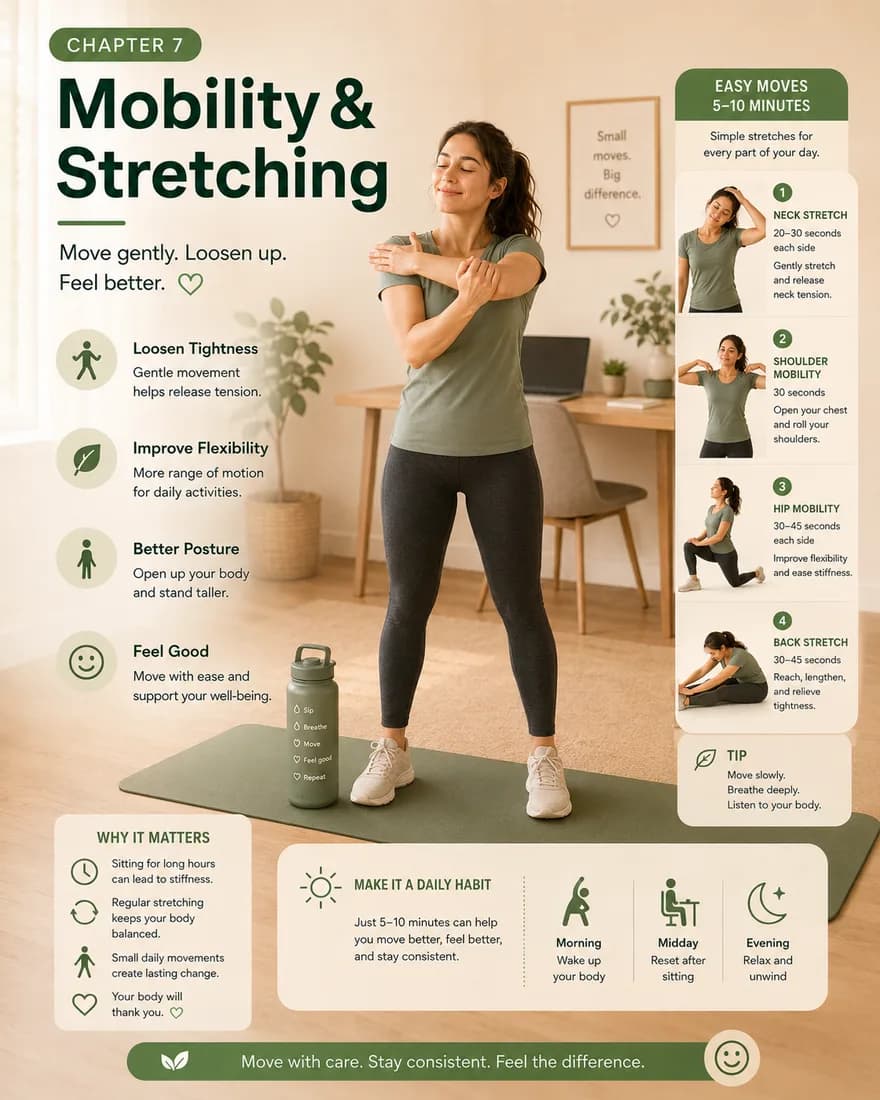
The neck and shoulders often become tense from phone use, computer work, stress, and poor posture. Common signs include tight traps, rounded shoulders, stiff neck, headaches, or discomfort after sitting. Simple movements can help: Shoulder rolls Neck turns Chin tucks Chest stretches Wall angels Band pull-aparts Gentle upper-back rotations Do not force your neck into painful positions. Move slowly. Breathe calmly. Think of the goal as reducing tension, not creating more.
Hips and Back
The hips and lower back are closely connected. When hips are stiff or weak, the lower back may take extra stress during walking, squatting, sitting, or lifting. Simple movements for hips and back include: Hip circles Cat-cow stretch Child’s pose Glute bridges Hip flexor stretch Seated figure-four stretch Gentle spinal rotations Bodyweight good mornings These movements help your body remember how to move through the hips instead of putting all pressure on the lower back. Gentle consistency is more important than intensity.
Knees and Ankles
Knee discomfort is common, especially for beginners, people carrying extra body weight, or people returning to exercise. Knees are affected by the hips, ankles, feet, and leg strength. Helpful gentle movements include: Ankle circles Calf stretches Heel raises Slow sit-to-stand Glute bridges Step-ups to a low step Terminal knee extensions with a band Gentle quad stretches If a movement causes sharp pain, stop and choose an easier option. Corrective movement should feel controlled and supportive, not aggressive.
Stretching Is Useful, but Not Magic
Stretching can help reduce tightness, improve body awareness, and make movement feel better. But stretching alone does not fix everything. If an area feels tight, it may need stretching, but it may also need strength, better posture, more movement, improved technique, or less time sitting. For example, tight hips may improve with stretching, but they often also need glute strength and more walking. Tight shoulders may need chest stretching, but also upper-back strengthening. Stretching is a tool. It is not the whole solution.
Corrective Movement Should Be Gentle and Consistent
Corrective movement means exercises that help improve posture, control, balance, joint movement, or weak movement patterns. It should not feel like punishment. You do not need to fix your whole body in one day. A few minutes of gentle movement done consistently can help more than one intense session done once and forgotten. Good corrective movement feels: Controlled Light to moderate Pain-free or low-discomfort Repeatable Focused on better movement quality Your goal is to teach your body better habits, not force it into positions it is not ready for.
Add 5 Minutes Daily
You do not need a long routine. Start with 5 minutes per day. You can do it: After waking up Before work During a work break Before a walk Before training After training Before sleep A simple 5-minute routine could be: 1 minute shoulder rolls and neck turns 1 minute cat-cow 1 minute hip circles 1 minute glute bridges 1 minute gentle stretching or breathing Small daily movement keeps stiffness from building up and helps your body feel more ready for exercise and normal life.
Common mistake
Forcing stretches too hard. Many people think stretching must be painful to work. That is wrong. Painful stretching can make the body tense up more and may increase irritation. A better approach is gentle pressure, slow breathing, and consistency. Stretching should feel like care, not a fight.
Practical tip
Use the “stiff area first” rule. Each day, choose the area that feels stiffest and give it 2 to 5 minutes of attention. Neck tight? Do gentle neck turns and shoulder rolls. Hips stiff? Do hip circles and glute bridges. Back tired? Do cat-cow and gentle rotations. Knees uncomfortable? Do ankle circles, heel raises, and slow sit-to-stand. Do not overcomplicate it. Listen to the body and move gently.
Today’s mission
Complete a 5-minute mobility or stretching routine today. Choose simple movements like: Shoulder rolls Neck turns Cat-cow Hip circles Glute bridges Ankle circles Calf stretch Chest stretch Gentle spinal rotations Move slowly. Do not force pain. The goal is to feel a little more open, aware, and connected to your body.
Follow this as a guided journey
Create a free account to unlock daily quizzes, missions, streaks and a coach that adapts to your progress.
Start free →