
Day 20
Progressive Overload Made Simple
Progress does not happen because you destroy yourself in one workout. Progress happens when you gently ask your body to do a little more over time. You do not need extreme training, heavy weights, or complicated numbers to improve. You only need a simple idea: Give your body a challenge it can handle, repeat it, and slowly make it a little better. Today, you will learn progressive overload in a beginner-friendly way — how to improve safely, track small wins, and build confidence without rushing.
What Progressive Overload Means
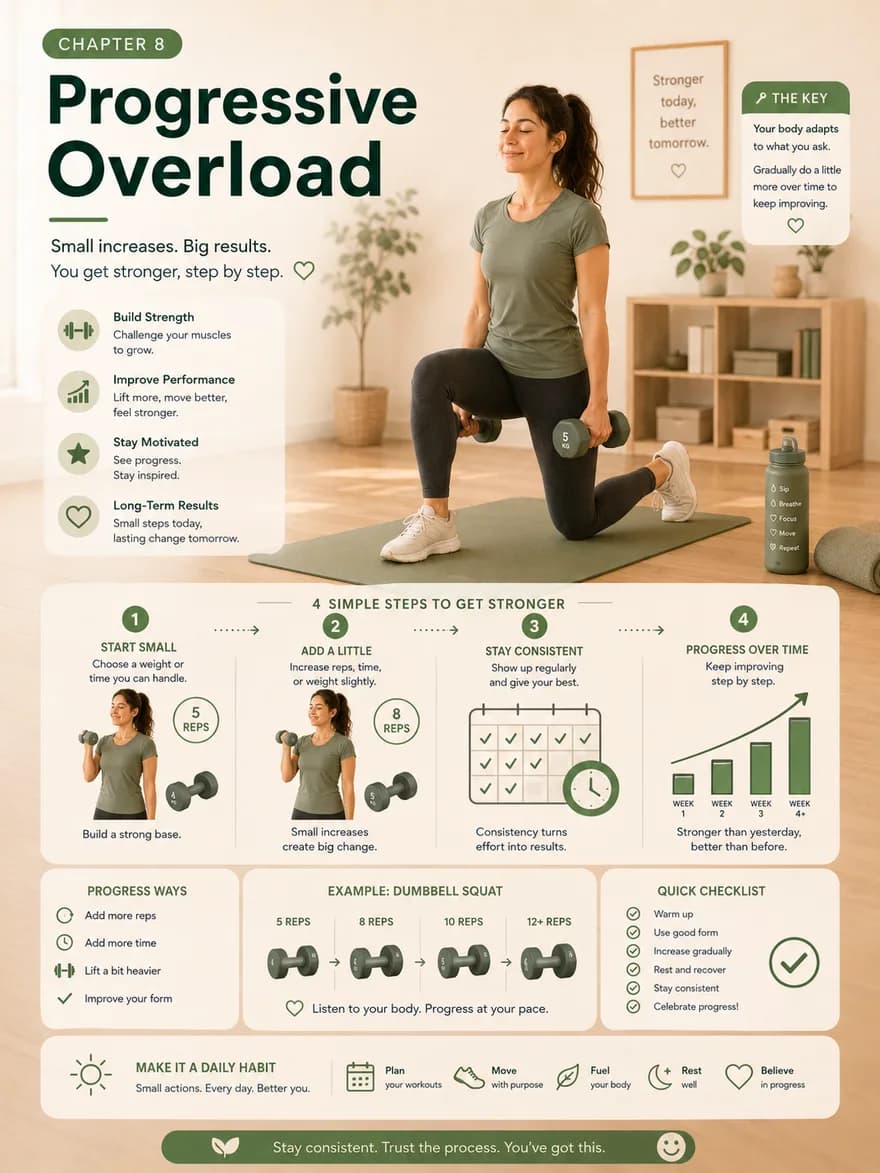
Progressive overload means gradually asking your body to do a little more than before. That “little more” can be very small. It does not always mean lifting heavier weights. It can mean walking a few minutes longer, doing one extra repetition, using better form, resting less between sets, moving with more control, or showing up more consistently. Your body changes when it receives a repeated signal: “This activity matters. Adapt to it.” Progressive overload is how your body learns to become stronger, fitter, and more capable.
Progress Has Many Forms
Progress is not only about more weight. For beginners, progress can look like: Doing more repetitions Using better form Walking for more time Walking at a slightly faster pace Using slightly more weight Feeling less tired after the same workout Needing fewer breaks Moving with better control Doing the same workout more consistently Feeling more confident in the movement This matters because some days you may not be ready to lift heavier or push harder. That does not mean you failed. If your form is better, your control is better, or you showed up again, that is still progress.
Why Repeating Workouts Is Useful
Many people think they need a completely different workout every day. But repeating workouts is one of the best ways to improve. When you repeat an exercise, your body gets a chance to learn it better. Your brain understands the movement more clearly. Your muscles coordinate better. Your confidence grows. If you change everything all the time, it becomes harder to know if you are improving. Repeating a simple routine helps you compare: Did I do more reps? Was the movement easier? Was my form better? Did I feel more stable? Did I recover better? Did I finish with more confidence? Repetition is not boring when you understand its purpose. Repetition is practice.
Doing Too Much Too Soon Is Risky
Progress should be gradual. Trying to do too much too soon can lead to soreness, pain, injury, exhaustion, or burnout. A beginner mistake is thinking: “If some exercise is good, a lot must be better.” But your body needs time to adapt. Muscles, joints, tendons, lungs, and your nervous system all need gradual exposure. The goal is not to prove how hard you can push today. The goal is to train in a way that lets you return tomorrow, next week, and next month. Safe progress beats fast burnout.
How to Progress Safely
Beginners should improve one small thing at a time. For example: Add 1 or 2 repetitions. Add 2 to 5 minutes to a walk. Use slightly better posture. Slow the movement down. Increase weight only a little. Complete one more workout this week. Reduce unnecessary breaks slightly. Improve breathing during exercise. Do not increase everything at once. If you add more weight, do not also add many more sets, reps, and intensity on the same day. Small progress is easier to recover from and easier to repeat.
Track Small Improvements
Tracking helps you see progress that your memory may forget. You can track simple things like: Exercise name Weight used Repetitions Sets Walking time Distance Energy level Pain or discomfort Mood after movement How difficult it felt from 1 to 10 You do not need a perfect training log. Even a short note is useful: “Walked 15 minutes.” “Did 8 squats with better form.” “Used light dumbbells and felt stable.” “Did the same workout but felt less tired.” These small records show you that your body is adapting.
Listen to Your Body While Progressing
Progressive overload does not mean ignoring pain. Challenge is normal. Sharp pain is not. A good workout may feel effortful, but it should still feel controlled. You should be able to breathe, keep form, and finish without feeling destroyed. Pay attention to signals: Mild muscle fatigue can be normal. Light soreness can be normal. Sharp pain is a warning. Joint pain should not be ignored. Extreme exhaustion is not the goal. Poor form means it is time to reduce difficulty. Progress is not just pushing forward. Progress is learning when to push, when to hold steady, and when to step back.
Consistency Is the Foundation
Progressive overload only works if you keep showing up. One intense workout followed by two weeks of quitting is not real progress. A simple routine repeated consistently is more powerful than a perfect routine done once. Before asking, “How can I do more?” ask: “Can I repeat this safely?” Once the answer is yes, then you can slowly add a little more. Consistency comes first. Progress builds on top of it.
Common mistake
Trying to improve everything at once. Adding more weight, more reps, more time, more workouts, and more intensity all at the same time can overload the body too quickly. A better approach is to choose one small improvement. One extra rep. One better set. One longer walk. One cleaner movement. One more consistent week. Small wins are still wins.
Practical tip
Use the “one step better” rule. Each workout, walk, or movement session, choose only one thing to improve. Examples: Walk 2 minutes longer. Do one extra repetition. Use better posture. Move more slowly and with control. Use a slightly heavier weight only if form stays good. Finish the session without rushing. Track what you did. Do not chase a huge jump. Chase one small upgrade.
Today’s mission
Improve one small thing in a workout, walk, or movement session today. Choose one: Walk a little longer than usual. Do one more repetition. Use better form. Move with more control. Warm up properly. Track your session. Repeat a previous movement with more confidence. Keep it safe and realistic. The goal is not maximum effort. The goal is one small step forward.
Follow this as a guided journey
Create a free account to unlock daily quizzes, missions, streaks and a coach that adapts to your progress.
Start free →