
Day 8
Why People Overeat
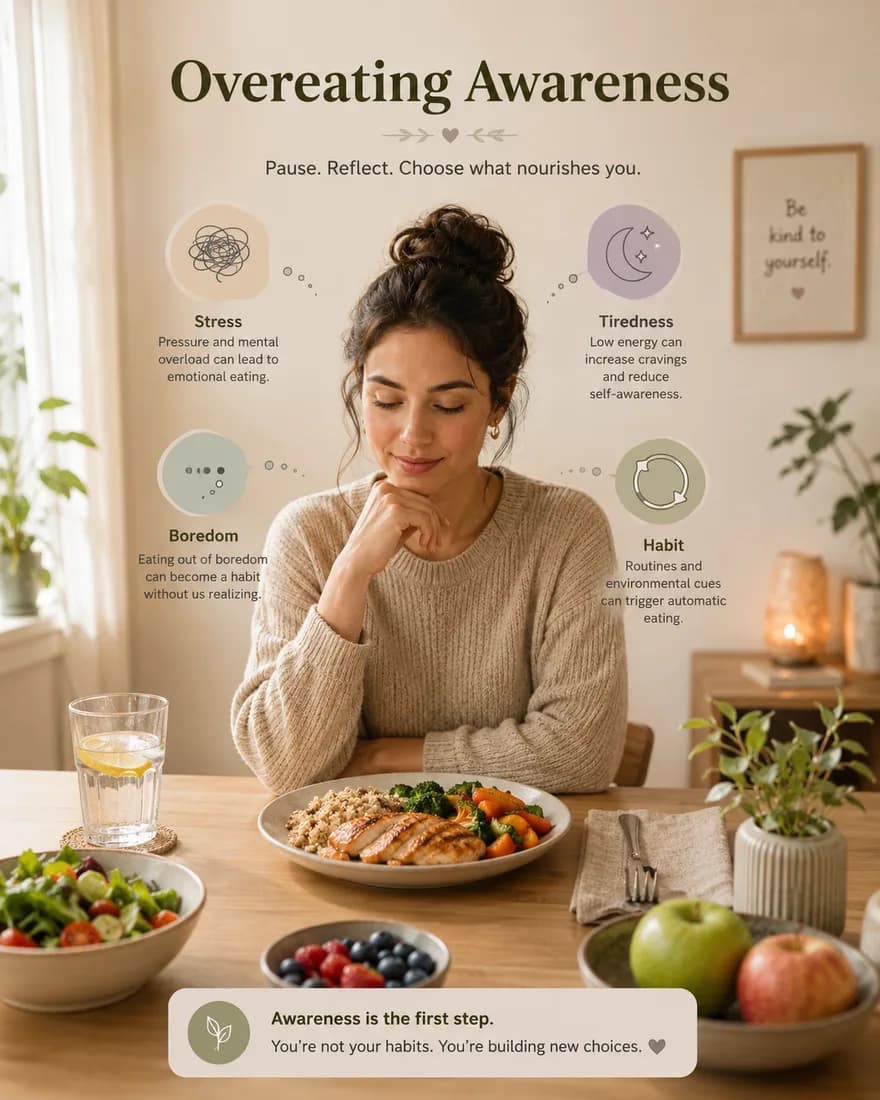
Overeating does not mean you are weak. It does not mean you lack discipline, and it does not mean you are broken. Many people overeat for reasons that have nothing to do with true physical hunger. Stress, boredom, tiredness, emotions, habits, social pressure, and environment can all affect eating. Today is not about guilt. It is about understanding. When you understand why overeating happens, you can stop judging yourself and start changing the pattern.
Overeating Is Not a Character Flaw
Many people feel ashamed after overeating. They think: “I have no control.” “I ruined everything.” “I am not disciplined enough.” But overeating is usually not a character problem. It is a behavior pattern. Patterns can be understood. Patterns can be adjusted. Patterns can be changed. The goal is not to hate yourself into better choices. The goal is to learn what is happening before, during, and after eating. Awareness gives you power.
Physical Hunger vs. Emotional Hunger
Physical hunger usually builds gradually. You may feel an empty stomach, lower energy, difficulty focusing, or natural hunger before a meal. Physical hunger is usually open to different food options. Emotional hunger often feels more sudden. It may show up as a strong craving for a specific food, especially something salty, sweet, creamy, crunchy, or comforting. Physical hunger says: “My body needs fuel.” Emotional hunger says: “I want comfort, relief, distraction, or reward.” Both are real experiences. But they need different responses.
Stress Eating
Stress is one of the most common reasons people overeat. When life feels heavy, food can become a quick way to feel better. It is available, familiar, and comforting. The problem is not that you wanted comfort. That is human. The problem is when food becomes your only way to handle stress. A better approach is to create more options: A short walk. A few deep breaths. A glass of water. A quick break from your screen. Writing what you feel. Talking to someone. Having a planned meal instead of random snacking. You are not trying to remove comfort from your life. You are trying to stop relying on food as the only comfort.
Boredom, Habit, and Automatic Eating
Sometimes people eat not because they are hungry, but because the situation tells them to eat. Watching TV. Working late. Driving. Scrolling on the phone. Passing the kitchen. Finishing someone else’s leftovers. Eating at the same time every night. This is automatic eating. Your brain likes routines. If you repeat a pattern often enough, it starts to feel normal, even when your body does not need food. The solution is not immediate perfection. The first step is simply noticing: “When do I eat without thinking?” That question can reveal a lot.
Social Situations Can Lead to Overeating
Food is part of connection. Family meals, restaurants, parties, celebrations, work gatherings, and nights out can make eating more emotional and less structured. Sometimes people overeat because they do not want to disappoint others, waste food, miss out, or feel different. You do not need to avoid social life to lose weight. You can practice simple boundaries: Choose what you truly enjoy. Eat slowly. Stop before feeling painfully full. Share a portion. Say no politely. Take leftovers home. Focus on the people, not only the food. A healthy life should still include real life.
Tiredness Can Increase Overeating
When you are tired, your decisions often become weaker. You may crave quick energy, skip balanced meals, order heavier food, or snack late at night. This does not mean you are lazy. It means your body is looking for energy and relief. Poor sleep can make hunger and cravings harder to manage. That is why rest matters in a weight loss journey. Sometimes the best nutrition decision is not another strict rule. Sometimes it is going to bed earlier, preparing an easier meal, or keeping simple protein options ready for low-energy days.
Pause Before Eating
A short pause can interrupt automatic eating. You do not need to pause for a long time. Even 10 seconds can help. Before eating, ask: “Am I physically hungry, emotionally hungry, or just following a habit?” This question is not meant to judge you. It is meant to wake you up. If you are physically hungry, eat a balanced meal or snack. If you are emotionally hungry, ask what feeling needs attention. If it is habit, decide whether you still want to eat or choose something else. The pause creates space between the urge and the action. That space is where change begins.
Notice Patterns Without Guilt
You cannot change what you refuse to see. But you also cannot change well if you attack yourself every time you notice something uncomfortable. The goal is honest observation. You might notice: “I snack more when I am stressed.” “I overeat when I skip lunch.” “I crave sweets when I sleep badly.” “I eat more at night when I am bored.” “I eat fast when I am emotional.” These observations are not failures. They are information. When you understand the pattern, you can build a better plan. Awareness turns confusion into direction.
Common mistake
Trying to fix overeating with shame. Shame may make you promise to be stricter tomorrow, but it usually does not solve the real trigger. If stress, tiredness, boredom, or habit caused overeating, punishment will not fix it. Understanding the trigger and building a better response will.
Practical tip
Use the “name it before you eat it” method. Before one eating moment, name what is happening: “I am physically hungry.” “I am stressed.” “I am bored.” “I am tired.” “I am eating because it is there.” “I am eating because everyone else is eating.” Naming the reason helps you move from automatic eating to intentional eating. You may still choose to eat — but now you are choosing with awareness.
Today’s mission
Before one eating moment today, pause and ask: “Am I physically hungry, emotionally hungry, or just following a habit?” Do not judge your answer. Just notice it. Then make the next honest choice.
Follow this as a guided journey
Create a free account to unlock daily quizzes, missions, streaks and a coach that adapts to your progress.
Start free →