
Day 24
Motivation Versus Discipline
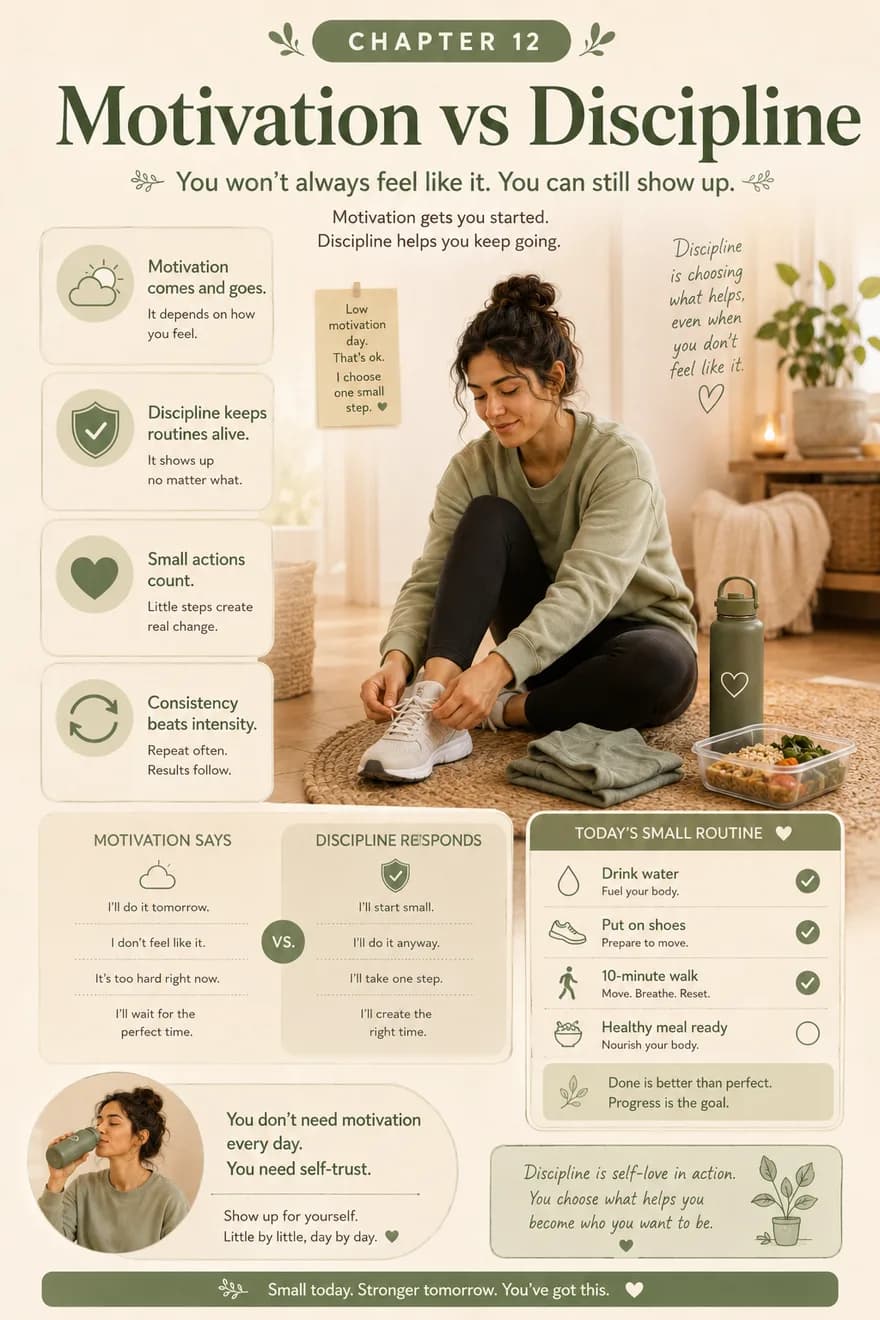
Some days you will feel motivated. You will want to eat better, move more, train harder, sleep earlier, and take care of yourself. Other days, you will not feel like doing any of it. That is normal. A successful health journey cannot depend only on motivation, because motivation changes. Real progress is built when you create simple actions you can repeat even when your mood is not perfect. Today, you will learn how to build discipline without becoming harsh with yourself.
Motivation Comes and Goes
Motivation is a feeling. It can be strong at the beginning of a journey, after seeing progress, after watching an inspiring video, or after deciding you are ready for change. But motivation can also disappear when life gets busy, stressful, boring, or difficult. This does not mean you are failing. It means you are human. Motivation can help you start, but it cannot be the only thing you rely on. Your journey needs something stronger than mood.
Discipline Is Built, Not Found
Discipline is not something you either have or do not have. Discipline is built through repeated actions. Every time you do a small healthy habit, you are training discipline. Drink water. Take a walk. Log a meal. Add protein. Prepare for sleep. Pause before a craving. Choose a smaller portion. Warm up before movement. These actions may look small, but they teach your brain: “I am someone who follows through.” Discipline grows when you keep promises small enough to keep.
Systems Are Stronger Than Moods
A system is a simple setup that makes the right action easier. Motivation says: “I hope I feel ready.” A system says: “I made this easier to do.” Examples of systems: Keeping a water bottle near your desk. Planning breakfast the night before. Keeping protein options ready. Putting walking shoes near the door. Scheduling gym days in advance. Logging meals after eating instead of waiting until night. Charging your phone away from the bed. Keeping trigger snacks out of easy reach. Systems reduce the amount of willpower you need. The easier the habit is to start, the more likely you are to repeat it.
Make Habits Easier
Many people make habits too big. They say: “I will train every day.” “I will never eat sweets again.” “I will cook every meal perfectly.” “I will sleep early every night.” “I will change everything this week.” Big promises feel powerful, but they can become heavy quickly. A better approach is to make the habit easier. Instead of “I will exercise every day,” try “I will walk for 10 minutes.” Instead of “I will eat perfectly,” try “I will add protein to breakfast.” Instead of “I will fix my sleep,” try “I will reduce screen time 15 minutes before bed.” Easy habits are not weak. Easy habits are how consistency begins.
Tiny Actions Count
Tiny actions matter because they keep the identity alive. A 5-minute walk counts. One glass of water counts. One honest food log counts. One balanced meal counts. One stretch counts. One earlier bedtime choice counts. One pause before eating counts. On difficult days, tiny actions may be the reason you do not quit completely. You may not always be able to do the full plan. But you can usually do one small version of the plan. That small version keeps you connected to the journey.
Prepare for Low-Motivation Days
Low-motivation days are not surprises. They are part of the process. Prepare for them before they happen. Ask yourself: “What will I do when I feel tired?” “What will I eat when I do not want to cook?” “What movement can I do when I have low energy?” “What is my minimum habit?” “What will help me return after an imperfect day?” Examples: If I cannot do a workout, I will walk for 10 minutes. If I cannot cook, I will choose a simple protein-based meal. If I crave snacks, I will pause for 10 minutes first. If I sleep badly, I will still drink water and take one short walk. If I miss a habit, I will return at the next opportunity. Preparation makes discipline easier.
Do Not Wait to Feel Ready
Many people wait for the perfect feeling before taking action. But action often comes before motivation. You may not feel motivated to walk, but after 5 minutes, you feel better. You may not feel like logging food, but after doing it, you feel more aware. You may not want to prepare a healthy meal, but after eating it, you feel proud. You may not want to sleep earlier, but tomorrow your body thanks you. Discipline is not about always wanting to do the habit. It is about doing a small helpful action even when the feeling is not there. Start small enough that you can begin without needing a perfect mood.
Build Trust With Yourself
Every small action is a vote for the person you are becoming. When you keep a realistic promise, you build self-trust. When you build self-trust, health habits feel less like punishment and more like identity. You begin to think: “I can return.” “I can handle imperfect days.” “I can keep going.” “I do not need to be perfect to be consistent.” This is the real power of discipline. Not harshness. Not guilt. Not pressure. Discipline is caring enough about your future self to take one useful action today.
Common mistake
Waiting for motivation before taking action. Motivation is helpful, but it is not reliable. If you only act when you feel motivated, your progress will stop whenever your mood drops. A better approach is to build small repeatable actions and simple systems that work even on ordinary or difficult days.
Practical tip
Create a “minimum habit.” Choose one health action so small that you can do it even on a low-energy day. Examples: Drink one glass of water after waking up. Walk for 5 minutes. Eat protein with one meal. Stretch for 2 minutes. Log one meal. Prepare one healthy snack. Pause before one craving. Go to bed 10 minutes earlier. A minimum habit keeps the chain alive.
Today’s mission
Choose one tiny daily health action that is easy enough to repeat. Use this sentence: “My tiny daily health action is…” Examples: “My tiny daily health action is drinking one glass of water after waking up.” “My tiny daily health action is walking for 5 minutes.” “My tiny daily health action is adding protein to breakfast.” “My tiny daily health action is logging one meal.” “My tiny daily health action is stretching for 2 minutes before bed.” Keep it small. Make it easy. Repeat it tomorrow.
Follow this as a guided journey
Create a free account to unlock daily quizzes, missions, streaks and a coach that adapts to your progress.
Start free →