
Day 21
Common Gym Mistakes for Beginners
The gym can feel confusing at first. There are machines, weights, mirrors, routines, advanced people, and too much advice everywhere. It is easy to feel like you need to do everything perfectly from day one. But beginners do not need complicated training. You need safety, good form, patience, and consistency. Today, you will learn the most common gym mistakes beginners make — and how to avoid them without fear or pressure.
Lifting Too Heavy Too Soon
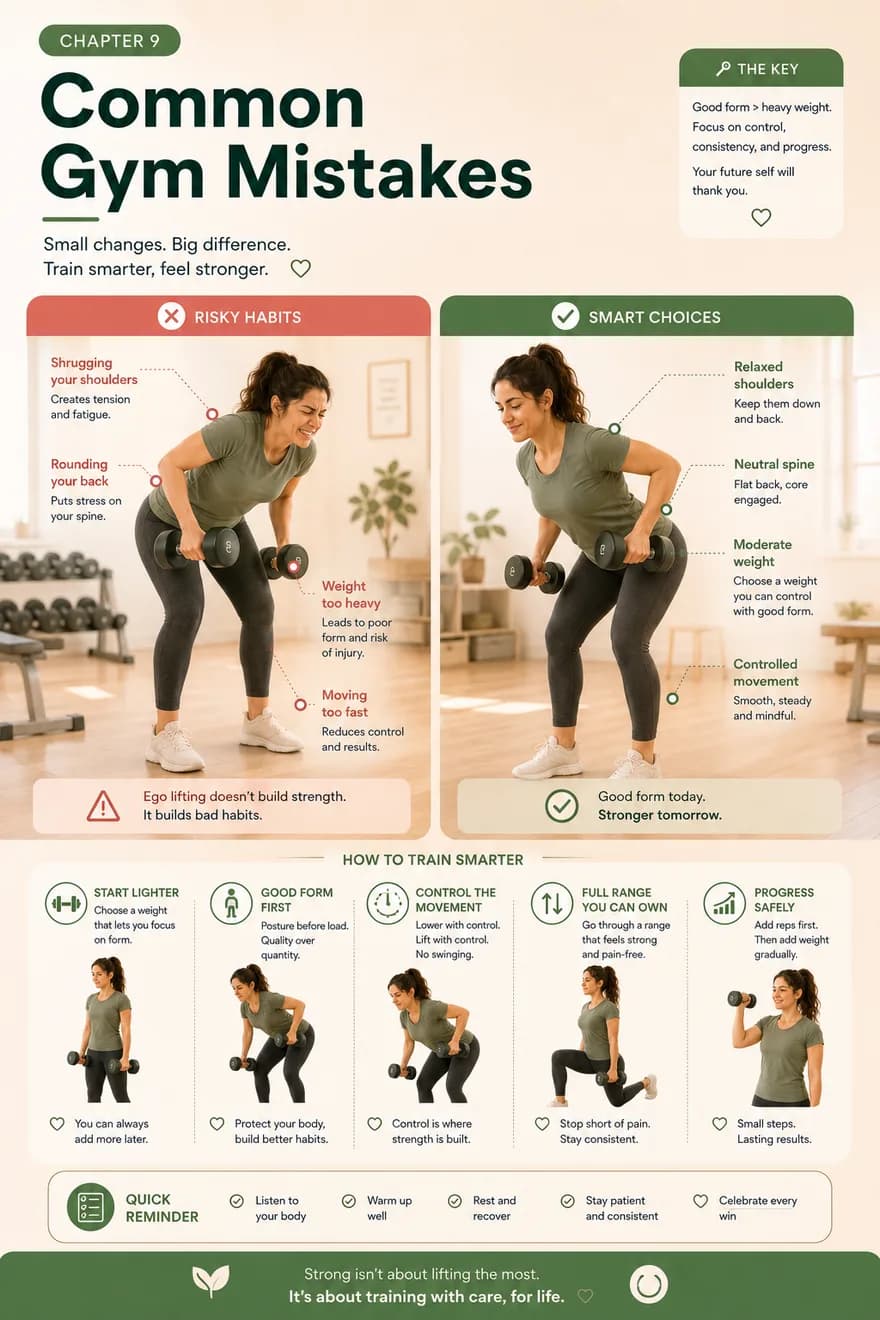
One of the most common beginner mistakes is choosing weights that are too heavy. Heavy weight may look impressive, but if you cannot control it, it is not helping you. When the weight is too heavy, form usually breaks down. You may swing the weight, rush the movement, hold your breath, or use the wrong muscles. This can increase discomfort and injury risk. A better goal is simple: Choose a weight you can control. You should feel challenged, but still able to move with good posture, steady breathing, and proper technique. Strength grows better when you respect the process.
Copying Advanced People
It is natural to look around the gym and copy what others are doing. But advanced people may be following routines that are not right for your body, experience level, goal, or injury history. They may use exercises, weights, or training volume that took years to build up to. Your job is not to train like someone who is already advanced. Your job is to build your foundation. A beginner-friendly plan should be clear, safe, repeatable, and focused on learning the basics first. Do not copy someone else’s chapter 50 when you are building chapter 1.
Ignoring Form
Form matters more than ego. Good form means doing each movement with control, alignment, and awareness. Poor form can make an exercise less effective and more stressful for your joints. For beginners, every exercise is also a skill. You are teaching your body how to move. Focus on: Controlled speed Stable posture Full but comfortable range of motion Breathing No sharp pain Using the target muscles Avoiding sudden jerky movement A lighter weight with good form is better than a heavier weight with poor form.
Skipping the Warm-Up
Many beginners skip warm-up because they want to save time. But a short warm-up helps prepare your joints, muscles, breathing, and heart rate. If your body is cold, stiff, or tired from sitting, jumping straight into training can make exercise feel harder and less comfortable. A warm-up does not need to be long. Five minutes of easy walking, light cycling, mobility, or lighter practice sets can be enough to help your body get ready. Start easy. Then train.
Training Too Many Exercises
More exercises do not always mean better results. Beginners sometimes try to do every machine, every muscle, and every exercise in one session. This can lead to confusion, exhaustion, poor form, and soreness that makes it harder to return. A simple full-body workout is often better. You may only need: One lower-body movement One push movement One pull movement One core movement Some light cardio or mobility A clear routine repeated consistently will teach your body more than a random workout with too many exercises. Simple is not weak. Simple is effective when repeated.
Not Resting Enough
Rest is part of training. Your muscles, joints, and nervous system need time to recover and adapt. Training hard every day as a beginner can lead to fatigue, soreness, poor performance, and loss of motivation. Rest does not mean laziness. It means your body is rebuilding. You can still stay active on rest days with walking, stretching, mobility, or light movement. The goal is not to destroy yourself every session. The goal is to train, recover, and return stronger.
Comparing Progress With Others
Comparison can steal your confidence. Someone else may lift more, move better, look fitter, or know more exercises. But they may have years of experience you do not see. Your progress should be compared to your previous self. Did you show up again? Did your form improve? Did you feel less nervous? Did you walk longer? Did you lift with more control? Did you recover better? Did you complete your planned session? These wins matter. Your journey is not a competition with strangers. It is a commitment to your own health.
Consistency Beats Intensity
A very intense workout can feel powerful, but it does not mean much if you quit afterward. Consistency is what changes your body. A moderate workout repeated three times per week is usually more useful than one extreme workout followed by pain, burnout, and missed sessions. Beginners should focus on building the habit first. Show up. Warm up. Use good form. Do a realistic amount. Recover. Repeat. Intensity can increase later. First, become someone who keeps returning.
Common mistake
Thinking a workout must feel extreme to be successful. A good beginner workout does not need to leave you destroyed. It should challenge you, teach you, and allow you to come back safely. Progress comes from repeated quality sessions, not from punishing your body once in a while.
Practical tip
Use the “two reps in reserve” rule. During a strength exercise, choose a weight where you could probably do about two more good repetitions if you really had to. This means the exercise is challenging, but not out of control. If your form breaks, the weight is too heavy. If you feel nothing at all, it may be too easy. If you feel challenged but controlled, you are in a good place.
Today’s mission
Choose good form over heavier weight in one exercise today. Pick one movement: Leg press Chest press Seated row Squat Wall push-up Glute bridge Dumbbell press Resistance band row Use a weight or difficulty level you can control. Move slowly. Breathe. Keep your posture steady. Today’s win is not lifting heavier. Today’s win is moving better.
Follow this as a guided journey
Create a free account to unlock daily quizzes, missions, streaks and a coach that adapts to your progress.
Start free →