
Day 27
Supplements Explained Honestly
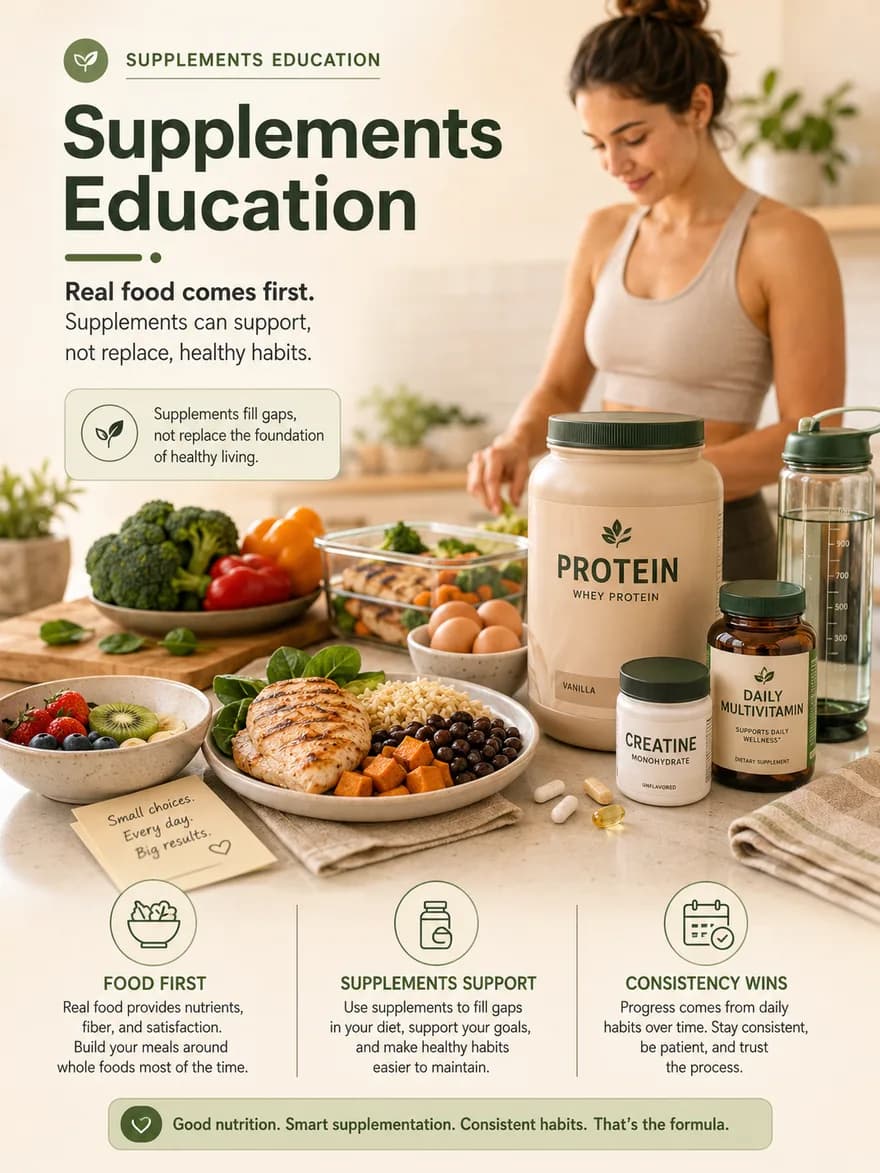
Supplements can be exciting. A powder, capsule, drink, or pre-workout can feel like the missing piece. It can promise faster fat loss, better muscle, more energy, stronger workouts, or easier progress. But here is the honest truth: Supplements are not the foundation of a health transformation. They can sometimes help, but they cannot replace food, movement, sleep, recovery, and consistency. Today, you will learn how to think about supplements clearly — without hype, fear, or unrealistic expectations.
Supplements Are Not the Foundation
A supplement is meant to supplement your routine. That means it is an extra support, not the main plan. If your meals are inconsistent, your sleep is poor, your training is random, and your habits are not stable, supplements will not fix the problem. The foundation is still: Balanced meals Enough protein Reasonable portions Regular movement Strength training Sleep and recovery Hydration Consistency over time Supplements may support a good plan, but they cannot rescue a plan that does not exist.
Food Comes First
Real food gives your body more than one nutrient. A balanced meal can provide protein, carbohydrates, fats, fiber, vitamins, minerals, water, and satisfaction. Supplements usually provide only one specific thing. For example, protein powder gives protein, but it does not replace the fullness and nutrition of a balanced meal with vegetables, carbohydrates, and healthy fats. A vitamin may help if you are low in something, but it does not replace a healthy eating pattern. Before asking, “What supplement do I need?” ask: “What basic habit needs attention first?” Often, the answer is food quality, portions, protein, sleep, or consistency.
Protein Powder Is Convenience, Not Magic
Protein powder can be useful. It can help if you struggle to eat enough protein, are busy, train regularly, or need a quick option after a workout. But protein powder is not magic. It does not automatically build muscle. It does not automatically burn fat. It does not replace strength training. It does not make calories irrelevant. Think of protein powder as a convenient protein source. It can help you reach your daily protein needs, but it should not become your whole diet. Real meals should still be the base.
Creatine Is a Common Performance Supplement
Creatine is one of the most common supplements used for strength and exercise performance. It may help some people train better, perform repeated efforts, and support strength progress when combined with proper training. But creatine is not a fat burner. It does not replace workouts. It does not replace protein. It does not create progress without training. It may also increase water stored in muscles, which can make body weight change slightly. If someone uses creatine, they should understand why they are using it, follow sensible dosing, stay hydrated, and consider health conditions or professional advice when needed. A supplement should have a clear purpose, not just hype.
Be Careful With Fat Burners and Extreme Claims
Fat burners often make big promises. They may claim fast weight loss, appetite control, boosted metabolism, or dramatic results with little effort. Be careful. Many fat burners rely on stimulants, caffeine, herbs, or strong marketing. Some may cause side effects like fast heartbeat, anxiety, sleep problems, digestive issues, or blood pressure concerns. The biggest issue is that they can distract from the real work. No fat burner replaces a calorie deficit, balanced nutrition, movement, sleep, and consistency. If a product promises extreme results with almost no effort, treat it with caution. Your health is worth more than a marketing claim.
L-Carnitine, Vitamins, and Other Supplements
Some supplements are popular because they sound scientific or are heavily promoted. L-carnitine, vitamins, minerals, omega-3, pre-workouts, greens powders, collagen, and many other products may have a place for some people. But they should be understood realistically. L-carnitine is often marketed for fat loss, but it should not be seen as a guaranteed fat-burning solution. Vitamins and minerals can be useful if you have low intake or a deficiency, but taking more does not always mean better results. Pre-workouts may increase energy, but they can also affect sleep or cause discomfort if they contain too much stimulant. The question should always be: “What problem is this supplement solving?” If you cannot answer clearly, you may not need it.
Safety Comes First
Not every supplement is safe for every person. Your health history matters. Supplements can interact with medications, medical conditions, sleep problems, blood pressure, heart issues, kidney or liver concerns, pregnancy, anxiety, or digestive problems. Some supplements may also have poor quality control or unclear ingredients. Before using supplements, especially strong stimulants, fat burners, high-dose vitamins, or unfamiliar products, it is wise to check safety. If you have a medical condition, take medication, or are unsure, ask a qualified health professional. Being careful is not fear. It is responsible self-care.
Build the Base Before Adding Extras
Supplements work best when the basics are already moving in the right direction. Before buying another product, check your foundation: Am I eating enough protein? Am I drinking enough water? Am I sleeping reasonably well? Am I training consistently? Am I walking or moving regularly? Am I controlling portions? Am I logging honestly? Am I recovering properly? If the answer is mostly no, start there. A strong foundation beats a shelf full of supplements.
Common mistake
Expecting supplements to do the work that habits should do. A supplement may support your routine, but it cannot replace consistent meals, training, sleep, recovery, and honest effort. The most important “stack” is not powders and pills. It is repeatable daily habits.
Practical tip
Use the “purpose check” before taking or buying any supplement. Ask: What is this supplement supposed to help with? Do I actually have that problem? Is there evidence or just marketing? Is it safe for me? Could I solve this first with food, sleep, training, or consistency? Would I still use it if progress was slow? If the purpose is unclear, pause before spending money.
Today’s mission
Before using or buying a supplement, write down what problem it is supposed to solve. Use this sentence: “I am considering this supplement because…” Then complete the thought honestly. Examples: “I am considering protein powder because I struggle to get enough protein from meals.” “I am considering creatine because I want to support strength training performance.” “I am considering a vitamin because I may not be getting enough from my diet.” “I am considering a fat burner because I want faster weight loss.” After writing it, ask: “Is this the real solution, or do I need to improve my habits first?”
Follow this as a guided journey
Create a free account to unlock daily quizzes, missions, streaks and a coach that adapts to your progress.
Start free →