
Day 29
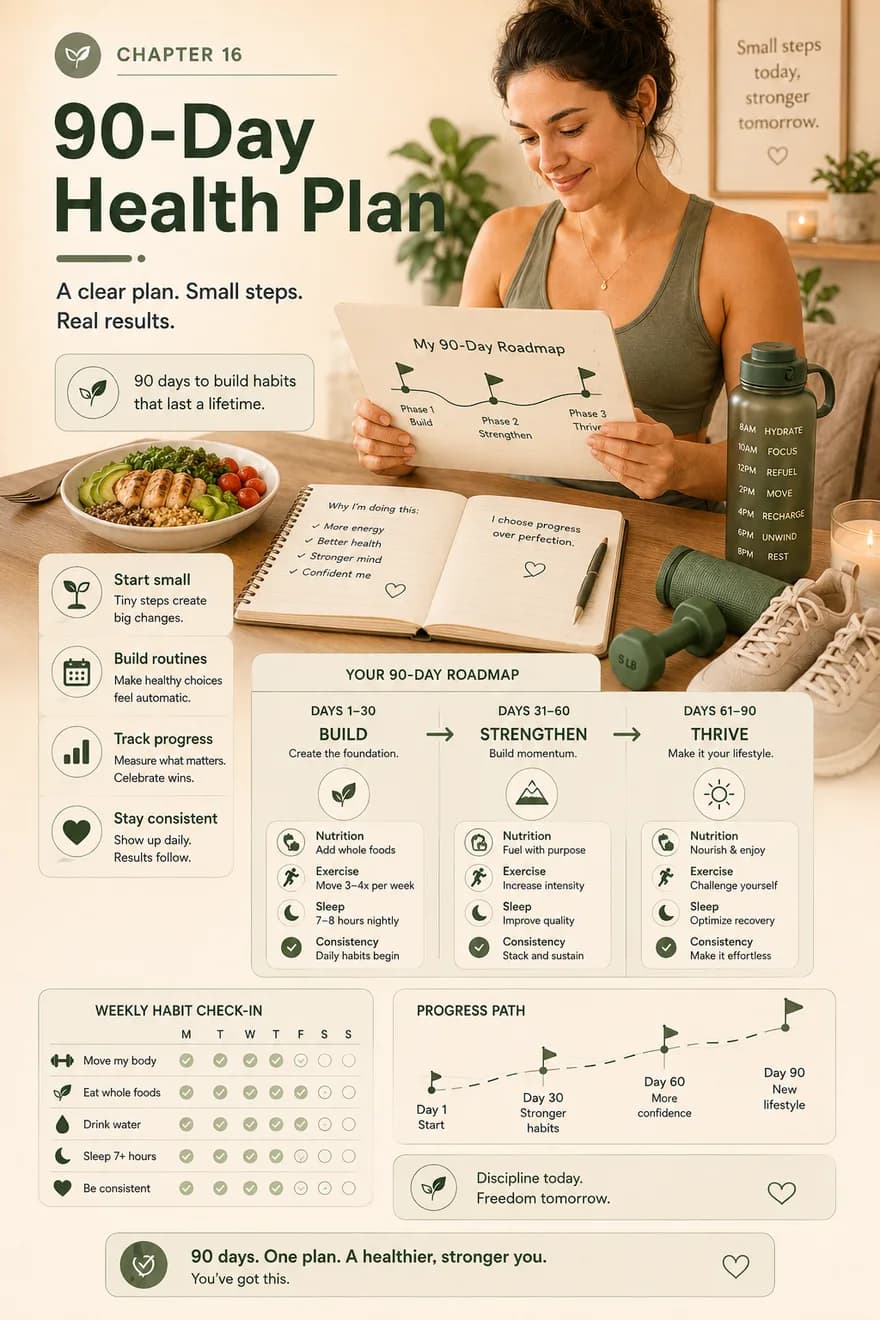
Creating Your 90-Day Health Plan
The first 30 days were never meant to be the whole transformation. They were the beginning. You learned how to understand food, movement, hunger, cravings, stress, sleep, progress, and consistency. You practiced small actions. You built awareness. You proved that change does not need to start with punishment or perfection. Now it is time to think beyond the first month. The next 90 days are your chance to turn this reset into a real lifestyle direction. Not a perfect life. A stronger plan.
The First 30 Days Are Only the Beginning
A 30-day journey can help you start, but real health change takes longer. That is not bad news. It is normal. In 30 days, you can build awareness, improve habits, and create momentum. But your body, mindset, fitness, and routines need more time to grow. Think of the first 30 days as your foundation. The next 90 days are where you build on it. You are not starting over. You are continuing with more experience.
Choose Your Next Focus
After the first 30 days, your next plan should have a clear focus. Trying to improve everything at once can become overwhelming. Choose one main direction for the next 90 days. Your focus might be: Weight loss Strength training Home workouts Gym training Better nutrition Sleep improvement Corrective training Walking and endurance Stress management Building consistency You can still work on other habits, but one main focus gives your plan direction. Ask yourself: “What would make the biggest difference in my health over the next 90 days?”
Set a Realistic 90-Day Goal
A good 90-day goal should be clear, realistic, and connected to your life. It should challenge you, but not break you. Examples: “I will lose weight steadily by improving meals, walking, and strength training.” “I will complete three gym sessions per week for 90 days.” “I will walk at least 5 days per week.” “I will improve my sleep routine and reduce late-night screen time.” “I will build a consistent home workout habit.” “I will reduce waist size by improving nutrition and movement.” “I will improve posture and stiffness with daily mobility.” Avoid goals that depend on perfection. A strong 90-day goal should answer: What am I working toward? Why does it matter? What habits will support it?
Choose 3 Key Habits to Continue
Your goal needs habits. A goal gives direction. Habits create the result. Choose three key habits that support your 90-day goal. Examples: For weight loss: Eat protein in two meals per day. Walk 20 to 30 minutes most days. Track meals honestly 4 to 5 days per week. For strength: Train full-body 3 times per week. Eat enough protein daily. Sleep 7 hours when possible. For better nutrition: Build one healthy plate per day. Reduce sugary drinks. Plan simple meals before shopping. For sleep: Reduce screens 30 minutes before bed. Keep caffeine earlier in the day. Prepare for bed at a consistent time. Three habits are enough. Do not overload the plan.
Plan for Obstacles
A realistic plan includes difficult days. You may face stress, travel, low motivation, social meals, poor sleep, work pressure, cravings, pain, or missed workouts. Do not wait until these obstacles happen. Prepare your response now. Ask: “What usually makes me lose consistency?” “What will I do when I miss a day?” “What is my smaller version of the habit?” “What meal can I choose when I am busy?” “What movement can I do when I am tired?” “What will help me return quickly?” Examples: If I miss the gym, I will walk for 15 minutes. If I overeat, I will return at the next meal. If I cannot cook, I will choose a simple protein-based meal. If I sleep badly, I will keep the workout light. If I feel stressed, I will take a 5-minute phone-free walk. Obstacles are not proof that the plan failed. They are part of the plan.
Review Progress Weekly
A weekly review helps you stay honest without becoming obsessive. Once per week, take 10 minutes and ask: What went well this week? What was difficult? Which habit did I repeat most? Which habit needs support? What did I learn from my food, movement, sleep, or mood? What is one adjustment for next week? You can also review: Weight trend Waist measurement Progress photos Workout consistency Walking time Sleep quality Mood Energy Cravings Clothes fit The weekly review is not a judgment. It is a check-in. You are not asking, “Was I perfect?” You are asking, “What should I adjust?”
Keep the Plan Flexible
Your 90-day plan should guide you, not trap you. Life changes. Your energy changes. Your schedule changes. Your body responds differently than expected. That is normal. A flexible plan is stronger than a rigid plan. If a habit is too hard, make it smaller. If a workout causes pain, adjust it. If tracking feels stressful, simplify it. If sleep is poor, focus on recovery. If weight stalls, review portions, movement, and consistency. Flexibility does not mean quitting. It means adapting so you can continue.
Build Identity, Not Just Results
The next 90 days are not only about numbers. They are about becoming someone who takes care of themselves consistently. Someone who returns after mistakes. Someone who moves their body. Someone who eats with more awareness. Someone who sleeps and recovers better. Someone who does not quit after one bad day. Someone who builds trust with themselves. Results matter, but identity keeps you going. Your goal is not just to finish 90 days. Your goal is to become the person who can keep building after 90 days.
Common mistake
Trying to make the next 90 days too aggressive. Many people finish a short challenge and immediately create an extreme plan: strict diet, intense workouts, daily training, no treats, perfect sleep, and no mistakes. That usually leads to burnout. A better 90-day plan should be challenging but realistic. The goal is not to impress yourself for one week. The goal is to continue for three months.
Practical tip
Use the “goal plus three habits” method. Write one 90-day goal. Then choose only three habits that support it. Example: Goal: Lose weight steadily over the next 90 days. Habit 1: Build one healthy plate per day. Habit 2: Walk 25 minutes at least 5 days per week. Habit 3: Strength train 3 times per week. Simple plans are easier to follow. Clear habits create clear direction.
Today’s mission
Choose one 90-day goal and three habits to support it. Use this format: My 90-day goal is: My three habits are: 1. 2. 3. Keep it realistic. Choose habits you can repeat on normal, busy, and imperfect days. This is not a fantasy plan. This is your next real step.
Follow this as a guided journey
Create a free account to unlock daily quizzes, missions, streaks and a coach that adapts to your progress.
Start free →